Despite recent moderating temperatures (March 2019) here in Riverdale, our recent cold snap is still a searing memory. Fortunately, we humans can retreat into warm homes and heavy clothing, but how do animals cope?
Looking through my windows, I still see some bird species gathering at my birdfeeder. I see sparrows everywhere and hear the raucous calls of the blue jays from the treetops. But with the exception of squirrels, the robust presence of animals seen in summertime is missing. And while not all insects are welcome, the total absence of insect life adds to the sense of desolation that winter brings.
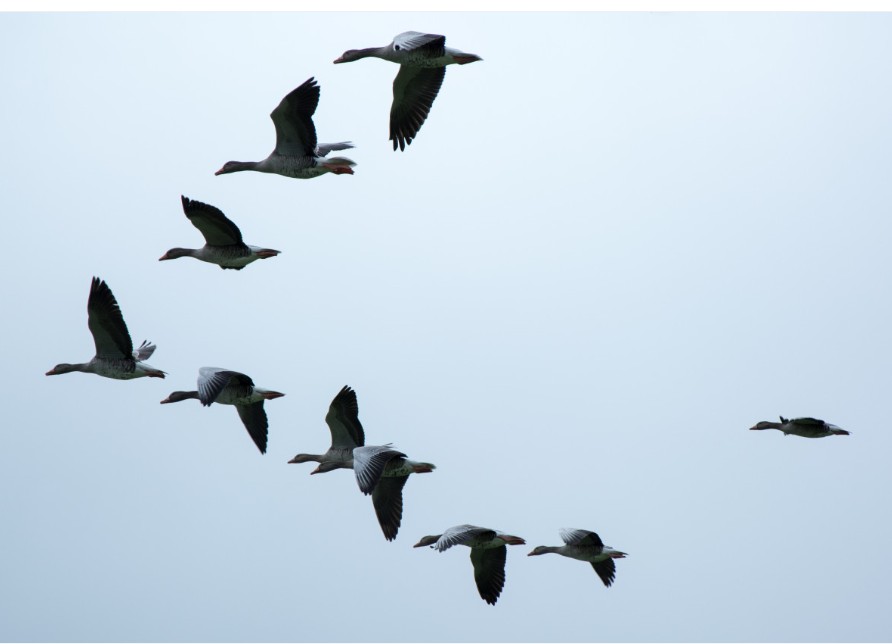
One well recognized method of cold avoidance in bird populations is migration, and more than 350 North American bird species migrate to the tropics each fall. Worldwide, approximately 4,000 species representing 40 percent of the total bird population migrate.
Insects may migrate as well. We are all familiar by now with the migration of the monarch butterfly. Traveling from Mexico to Canada, they fly a full 3,000 miles.
Mammals are not exempt. Humpback whales travel between 2,500 and 4,000 miles as they move between winter calving locations and summer feeding grounds traveling at a steady daily pace of one to six miles. Caribou living in North America, Europe and Siberia travel approximately 400 miles between winter and summer locations.
Migration is the answer to problems other than cold. Wildebeest, accompanied by gazelles and zebras, migrate 1,500 miles in the course of a year as they move clockwise through Kenya and Tanzania. However, they are chasing water and forage, not warmth.
Unless you are a fisherman chasing fish populations, you probably have not given much thought to fish migrations. Yet, salmon and striped bass are anadromous, meaning that the adult fish live in the sea, but return to fresh water to spawn. Catadromous fish such as eels do the reverse in that the adult fish live in fresh water and return to the ocean to reproduce.
Yet other species, such as a variety of herring, migrate from their spawning ground in southern Norway to their feeding ground in Iceland in a yearly trek.
There also is the extraordinary daily vertical migration in the ocean of zooplankton referred to as diel vertical migration where dies is Latin for “day” referring to periods of 24 hours. These creatures move up and down the water column on a daily cycle. The name plankton comes from the Greek planktos for “wandering and zooplankton incorporates the Greek word zoon for “animal.” These simple animals — characterized by their drifting on ocean currents — are divided into two groups: the meroplankton and the holoplankton. The meroplanktons are the larvae of various species such as worms, mollusks, coral and fish, and as such will change form and size as they mature. The holoplankton will retain one form for their entire lifecycle.
Vertical migration usually involves the movement of the zooplankton from the depths during nighttime hours to the upper reaches of the water where they will feed on the phytoplankton — small photosynthetic organisms — that have been producing during daylight hours. Phyton, also from the Greek, means “plant.” As the night fades, they return to deeper waters.
The current hypothesis for this behavior is that the zooplankton are less visible to predators in lower-light areas, and so stay out of sight during the day in darker, deeper waters.
But what of the animals that do not migrate? I am always amazed to see birds active in extremely cold weather seemingly untroubled by unprotected pencil-thin legs.
The only explanation I have found is called counter-current heat exchange. This means that arteries which carry warmed blood, and veins which carry cooled blood returning to the heart, are in close proximity to each other. This promotes the transfer of heat from the arteries directly to the veins which keeps the body core warmer by limiting heat loss through the extremities.
Apparently, counter-current systems are used frequently in biological systems. The basic requirements are semi-permeable membranes which will allow exchange of some factor throughout the vessel walls. Veins and arteries must be in close proximity with material moving in opposite directions, and a gradient of material between the two vessel types, meaning that one vessel has a greater concentration of some factor than the other. Other animals that use counter-current exchange for heat-related issues are whales, manatees and beavers. This same system also is used for water “breathing,” as in gills of fish where the exchange involves oxygen.
Kangaroo rats, which live in arid and semi-arid environments, use such a system to retain moisture. To prevent the exhalation of moisture, counter-current exchange allows them to inhale the dry outside air, moistening it before it reaches the lungs. The moisture is recondensed and retained before the air is exhaled through the nose.
But what of other animals that do not migrate, nor have special adaptive pathways?
Hibernation has caught the public’s imagination again through science-fiction. Until we can conquer the limitations of space travel where lifetimes would be consumed in the journey to nearby solar systems, we have to create completely self-sufficient speeding miniature worlds or crews in suspended animation.
Already there are several recorded cases of people such as toddler Erika Nordby although trapped in low temperature conditions for periods of time were successfully re-warmed It should be pointed out that those patients successfully rewarmed were not frozen or otherwise chilled for more than a few hours. This has led to the medical maxim that “You’re not dead until you’re warm and dead.” Hypothermia is also used as a medical technique to save patients with severe medical complications such as shock and traumatic injuries. Indeed, NASA already is studying the use of hypothermia as a tool for an upcoming Mars mission.
Different mammals utilize one of two techniques to counter harsh environments — torpor and hibernation. There is some speculation that these two conditions actually lie along a single spectrum.
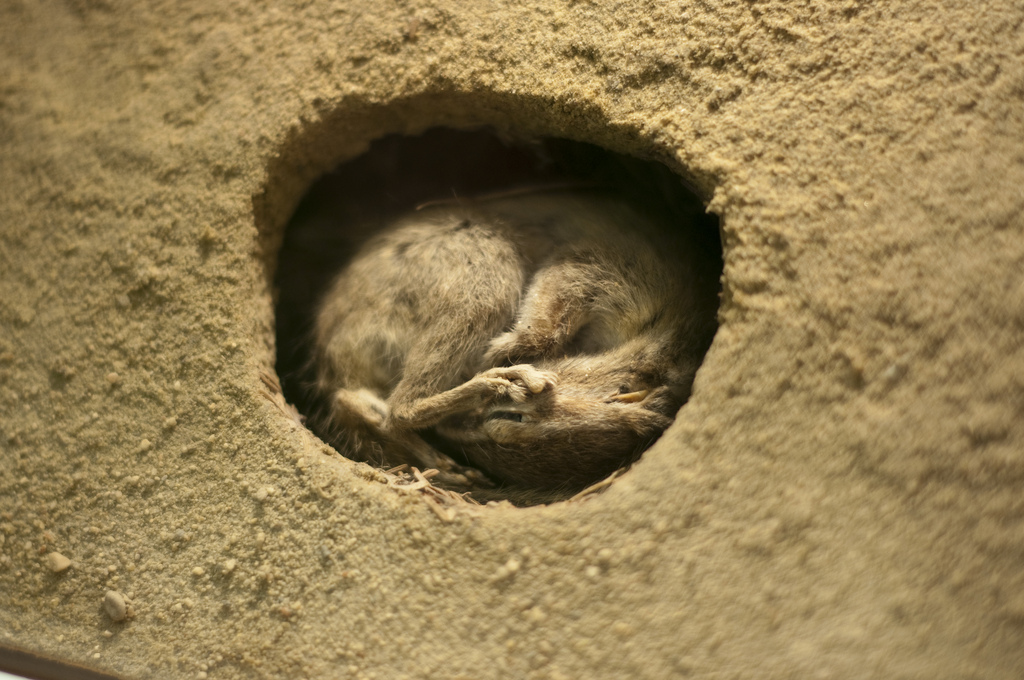
Hibernation itself is divided into two categories. Obligate hibernation refers to the situation when a species enters hibernation annually and spontaneously, regardless of the outdoor conditions of temperature and food. Facultative hibernation occurs only when the animal faces cold or food stress.
Obligate hibernators include yellow-bellied marmots (Marmota flaviventris), dwarf lemurs (genus Cheirogaleus), and a beautiful butterfly — the small tortoiseshell (Aglais urticae). Notice I did not mention bears which are generally associated with hibernation. I will get to them further down in this article.
Examples of facultative hibernators include black-tailed praire dogs (Cynomys ludovicianus) and the eastern chipmunk (Tamias striatus).
Fittingly, the overwintering structure that an animal creates — such as a den, or exploits such as a cavity within a rock pile — is called a hibernaculum, from the Latin meaning “a tent for winter quarters.”
Characteristics of hibernation include severely reduced body temperature, breathing rate (below 50 percent normal), heart rate (as low as 2.5 percent of normal), and metabolic rate in order to conserve energy during dangerous environmental conditions.
Such a hibernating animal will not awaken if touched or subjected to loud noise, as it is a deep sleep.
Hibernation lasts for long periods of time — many weeks, or even months.
Prior to entering hibernation, animals undergo a hyperphagic (overeating) phase in which the extra calories are stored as white adipose (fat) tissue, which is the primary fuel during hibernation. This is in contradistinction to the non-hibernating state when the animals utilize carbohydrates for energy.
Using white fat for energy helps preserve muscle tissue so the animal does not emerge from hibernation in a weakened state. Hibernators also have supplies of brown adipose tissue, which is used for the production of the residual body temperature maintained during hibernation.
This tissue contains large numbers of mitochondria, cellular organelles responsible for energy and heat production. Hibernating animals do not defecate or urinate. Since food is not traveling through the digestive system, there is no solid material to pass.
The waste product urea normally found in urine is recycled into amino acids (the building blocks of protein).
Torpor is a short-duration hibernation. Some species, such as birds, will undergo a daily torpor, which is not seasonally dependent when calorie expenditure is unnecessary. Cold-weather torpor, which can last for days or weeks, lowers metabolism to enhance survivability under adverse conditions. Arousal can take an hour, and involves noticeable shivering.
Skunks and raccoons use torpor to survive the winter. Bears, while popularly known as hibernators, actually occupy some intermediate position. While they undergo a lengthy quiescent phase with reduced breathing, heartbeat and metabolic activity, their body temperature does not undergo the dramatic drop toward the freezing point of water seen in many hibernators.
One bird species, the common poorwill (Phalaenoptilus nuttallii) found in the western United States and northern Mexico, is usually described as a hibernator, but also probably just goes into a lengthy torpor.
Reptiles and amphibians — cold-blooded animals — also have to deal with extreme cold. In their case, the process is called “brumation.” While their body temperature, heart rate and respiratory rates are greatly reduced, they still need to drink water during this period, although they do not require food. Therefore, they will wake episodically to find water.
Meanwhile, they will den in rock crevices or burrows, sometimes alone — or, in the case of garter snakes, there may be numerous animals denning together.
Insect development may be halted in a stage called “diapause,” which is common from autumn to spring. This delay allows the emergence of the young larvae only when favorable conditions have resumed.
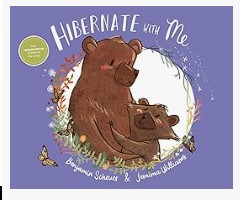
I was sitting in the dentist’s office the other day, where a television news program was airing. The host was talking about a new children’s book called “HibernateWith Me.”
I may just give it a look!