A friend of mine was a nature counselor at day camp in Rockland county. Thinking that having a harmless, local snake would be an educational opportunity for the campers, he asked the camp maintenance staff to bring him a snake if they ran across one. He was expecting that they would eventually find a garter snake.
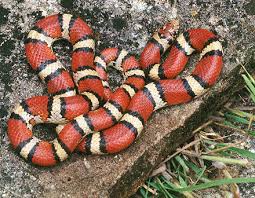
But one day, they came running to the nature center holding a closed bag by the neck with a head of a snake poking out. One look told him this was not a garter snake and he was concerned that it might be a copperhead which is also local but poisonous. They were able to dump it safely into a glass tank and it was a beautifully banded snake with red, black and white bands. Contacting the local State biologist, they found out that they had a milk snake, which is safe to handle.
Captured Local Snake-Mike Pingleton
Common Garter Snake- Brian Gratwicke
After a few days, they returned the snake to the wild.
Snake Identification
When I first saw the photos, however, I was quite taken aback. While I do not know much about snakes, I find them extremely graceful and quite beautiful. However, the only banded snake I was acquainted with was the coral snake, which is not local, but is indeed poisonous.
Coral Snake-Coutesy Bernard Dupont
Now the question arises, how do you quickly decide if you are confronting a harmless banded snake when you have little expertise? It turns out that this is a reasonable question, and there is doggerel to help you out.
Looking at photos of the milk snake shows bands in black, red and white. The poem states, “Red touch yellow, kills a fellow,” paired with “Red touch black, venom lack.”
Where Do Sinkholes come in?
Devil's Millhopper Sinkhole-Michael Rivera
At the time we were on a road trip heading for Florida, making many stops along the way. As fate would have it, we were at Devil’s Millhopper Geological State Park in Gainesville. This park highlights a sinkhole created about 10,000 years ago.
Sinkholes are common in Florida because the underlying surface is limestone which gradually erodes due to acidic rainfall until the surface collapses, leaving huge holes behind. This particular sinkhole is 120-feet deep and 500-feet across. The vegetation growing along the slopes into the bottom is similar to that found in the Southern Appalachians rather than the local Florida flora. This is probably due to the fertile, moist soil, dense shade and flowing streams, which are characteristic of the Southern Appalachians.
In any case, Florida is the home of several venomous snakes, and there was a poster describing them. Of course, one was a coral snake, and I was trying to show my husband how to distinguish a coral snake from its non-venomous lookalikes.
As I start reciting “Red touch yellow…,” two voices chimed in over my shoulder but with slightly different versions. One was “Red and yellow, kill a fellow, red on black, venom lack.” They turned out to be two local exterminators who also have to deal with snakes.
The Venomous Snakes of Florida
In addition to the coral snake, Florida has five other venomous snakes — the southern copperhead, the water moccasin (or cottonmouth), the eastern diamondback rattler, the canebrake rattler and the dusky pigmy rattlesnake.
Southern Copperhead- Paul Cooper
Watermoccasin-picryl
Eastern Diamondback Rattler-Animalia.bio
Canebrake Rattler-Glenn Bartolotti
Dusky Pygmy Rattlesnake-Fish & Wildlife Research Institute
Venomous Snakes of New York
New York State has only three poisonous snakes — the timber rattlesnake, the copperhead, and the Massasauga, which also is a type of rattlesnake.
Timber Rattlesanke-Peter Paplanus
Eastern Copperhead-Peter Paplanus
Massauga- Oeropium
All of these, fortunately, are quite rare.
I cannot stress enough, however, that if you encounter a snake and are not clear about identification, the snake should be carefully left alone.
Encounter in Riverdale
In all my years of gardening, I have seen a snake on my property only once. When digging in the soil, I tend to lift up any earthworms that I have disturbed and put them aside to go on their way.
Earthworm-Rob Hille
One day, I saw a rather long earthworm, and without thinking, I picked it up, and you have never seen two such startled creatures in your life. I’m looking at this animal, and it is no earthworm. It’s looking at me, holding quite still, as if wondering what I will do next.
I do not have a clear recollection of exactly what happened next, but that little snake and I parted company suddenly.
The Bronx Zoo has a well-supplied reptile house, and it is always a treat to go there where there is a strong glass barrier between me and the beautiful snakes in their collection.
Surale,
Thank you so much for your detailed information.
I have not yet read it, but it surely awaits me for tomorrow night.
Have a nice weekend,
שבת שלום
All my love,
Nechama


Surale,
Thank you so much for your detailed information.
I have not yet read it, but it surely awaits me for tomorrow night.
Have a nice weekend,
שבת שלום
All my love,
Nechama