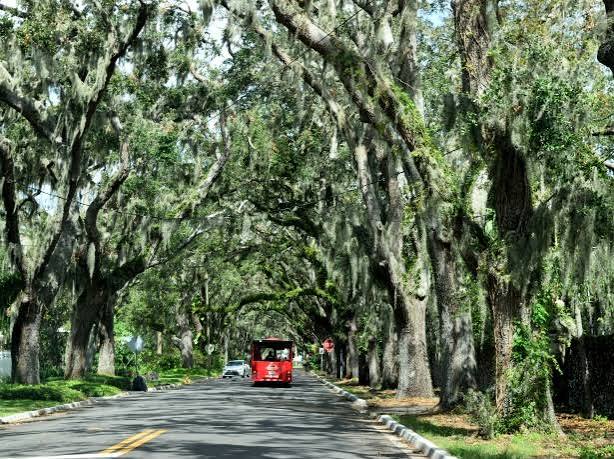
Although road trips were “a thing” back in the 60s and 70s, we never had time for one. Then in 2017, we decided to head for Sanibel Island in Florida with myriad stops along the way. This was in June before the schools closed for the summer, so the attractions along the way were busy without being overcrowded. In case you are wondering about the destination, Sanibel Island is world famous as a destination for avid shell collectors. While you won’t see me out in the early hours for almost any reason, I think shells are among Nature’s most beautiful creations and I wanted a chance to just wander the beach for hours, searching for treasure.
Road Trip in Florida- Pickpic
Assorted Seashells-Pixabay
Once Again, With Love
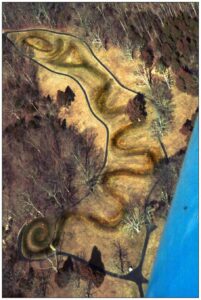
Aerial View of Great Serpent Mound-Wikimedia
Finally, we decided that it was time for another trip and another item on my bucket list has always been the Great Serpent Mound in Peebles, OH. Despite Hollywood’s depictions of Native Americans, there have been agricultural civilizations with elaborate rituals and artifact and the Great Serpent Mound is one of them being the largest effigy mound in the world depicting a snake.
The mound is approximately 1,300 feet long and because the present height varies from 1-3 feet, it is most clearly viewed in its entirety from an observation tower. Unfortunately, that tower was closed for repairs when we arrived so the mound did not seem as impressive as it should have been.
Have You Heard of the Adena People?
While there is disagreement between archeologists as to the exact date and culture involved, the mound was believed to have been started around 300BCE by the Adena people (500BCE-100CE) and work continued over several hundred years with extensive repairs being done around 1100CE.
Despite the Adena being hunter-gathers living in small groups they were able to construct this huge and artistic mound in addition to numerous other non-effigy mounds. They cultivated pumpkin, squash, sunflower, goosefoot (Chenipodium berlandieri) and erect knotweed ( Polygonum erectum). Notice that maize was not yet included in this list only arriving in Eastern North America approximately 1200CE.
Grave Creek Mound by the Adena- Bill Badzo
Chenopodium berlandieri-Matt Lavin
Polygonum erectum-Cbaile19
Mound Building by Native Americans
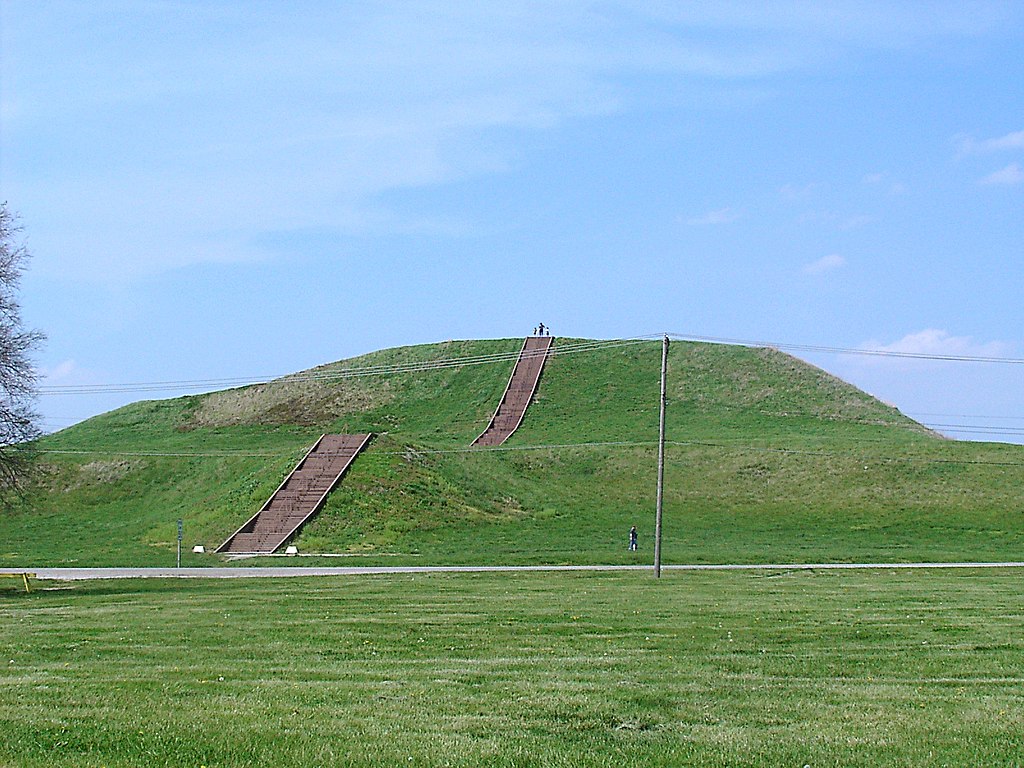
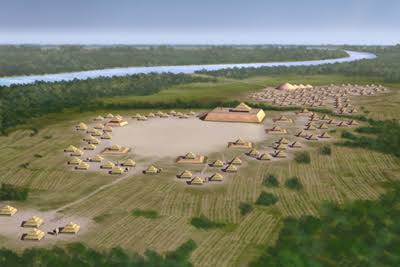
It should be pointed out that mound building started long before the construction of the Great Serpent mound with reliable dates of 4000BCE at sites in Louisiana with mounds numbering in the hundreds of thousands. Other cultures, such as the one that built the extensive Cahokia Mound Complex near St. Louis (c 600-c 1350 CE) numbering 120 mounds including the huge Monk’s Mound were the result of human labor only over lengthy periods of time. There were no serious beasts of burden in the New World. Their urban center was inhabited by approximately 15,000 people and was the nexus of a large trade network.
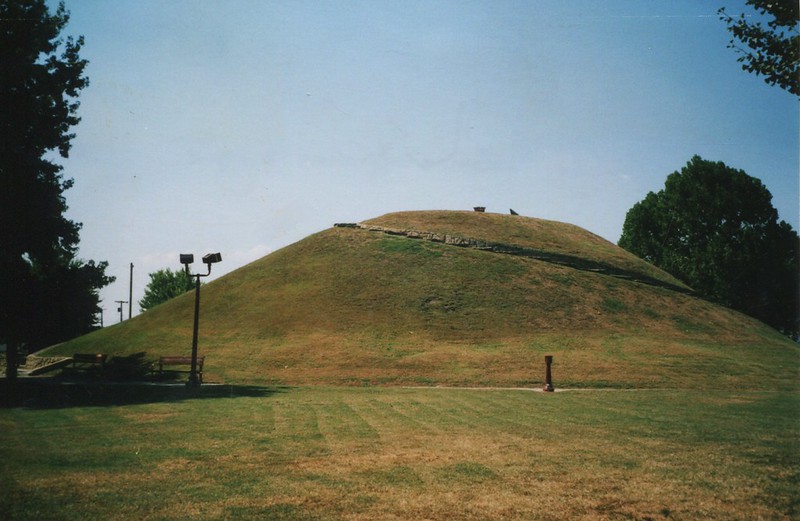
In addition to the conical and effigy mounds, there were other shapes. These included platform mounds such as Monk’s Mound at Cahokia and multi- lobe Mounds found at Spiro, OK.
Monk's Mound at Cahokia-https://www.worldhistory.org/cahokia/
Multi-Lobed Mound at Spiro, OK-HRoe
Mound Construction
One of the great questions about the mounds was how they were built and how the earth used to make them was stabilized. In the 1930s an archeologist named Winslow Walker, endeavored to answer that question. “Layer after layer of dirt was sandwiched between split-cane matting secured by wooden stakes to stabilize the mound fill. A wooden plank floor was exposed; palmetto fronds were used for floor cover. A palisade was set along the foot of the mound, and log steps ascended one corner. At least five split-cane domes of unknown function were incorporated into the mound fill. There can be no doubt that engineering played an integral role in building the Great Mound of Troyville.”
Many, many mounds were destroyed by being plowed for fields or built over for dwellings. In general, most locals could not figure out who built these structures since the prevailing assumption was that the Native Americans were incapable of such large and complicated works. The theories ranged from a lost race to Atlantis to ancient voyagers from known civilizations such as the Phoenicians.
It turns out that earthen construction is an age-old method which is now seeing a revival. The next installment will look into this further.



How did you find out about these works that were created centuries ago?